Loading Meshes
Meshes can be loaded by right-clicking on any segment and selecting Load Mesh (precomputed) or Compute Mesh (ad-hoc) from the context menu.
Alternatively, the Segments tab in the right-hand side panel allows you to load the mesh for any segment or whole group of segments listed there. Hover over a segment and click its mesh button: if a precomputed mesh file is available, you can choose between the precomputed and the ad-hoc mesh, otherwise an ad-hoc mesh is computed. The same options are available by right-clicking a segment or group. Once loaded, the mesh is shown as a chip in the segment's row. Click the chip to show or hide the mesh.
Note that the segmentation layer must be visible to load or compute meshes; otherwise the corresponding actions are disabled.
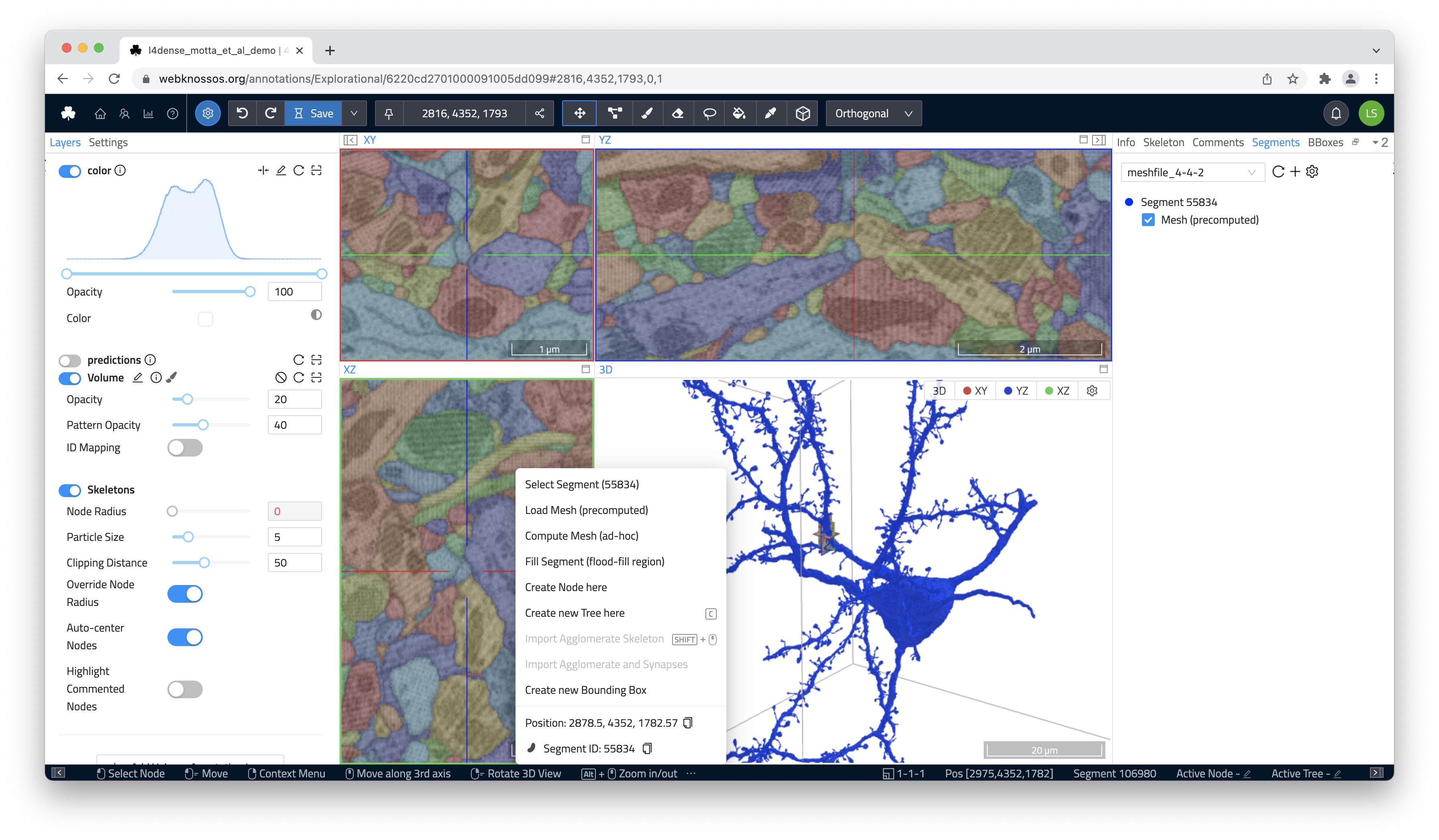
Meshes can be loaded from the context-sensitive right-click menu
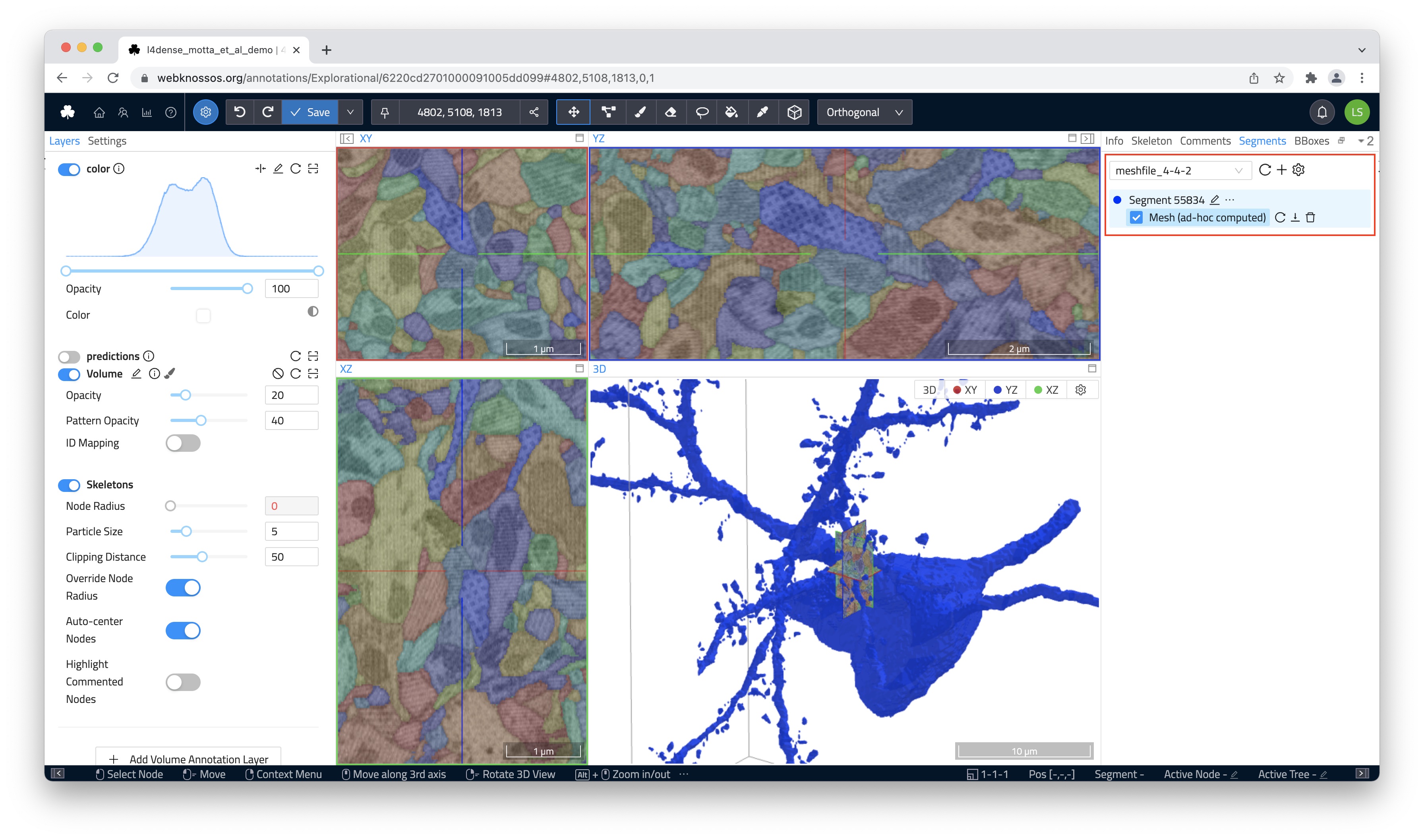
The Segments Tab lists all loaded meshes.
Ad-hoc Meshes
Ad-hoc meshes are computed on demand for individual segments. The mesh quality can be configured from the same settings (gear icon) popover in the Segments tab header. Higher quality produces a more detailed mesh but requires more computational resources and takes longer to compute.
Note that ad-hoc mesh computation can take a significant amount of time for large segments, as the server needs to load and process a large amount of voxel data. For datasets where you regularly work with large segments, consider generating precomputed mesh files instead.
Precomputed Meshes
Precomputed meshes have already been computed for all segments in the dataset and load almost instantly, even for large meshes.
A dataset can have multiple precomputed mesh files, for example one per magnification level. Coarser magnifications produce coarser meshes that load faster, while finer magnifications yield more detail at the cost of longer load times. To switch between mesh files, click the settings (gear) icon at the top of the Segments tab and select the desired file from the dropdown. The reload button next to the dropdown refreshes the list if new mesh files have been added.
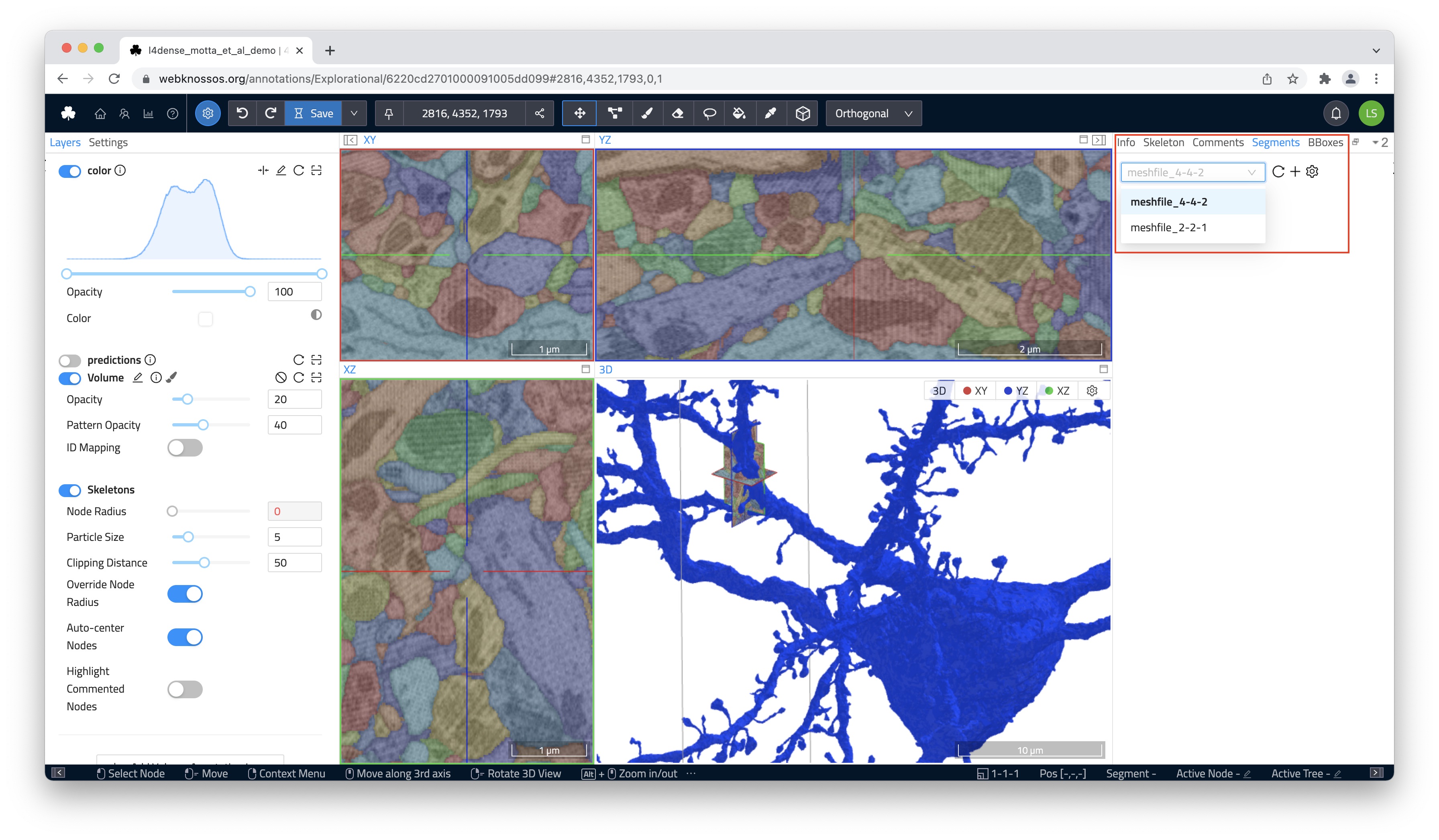
If you have more than one mesh file precomputed, e.g. based on different magnifications, they can be selected from a dropdown.
Generating Precomputed Mesh Files
Instead of computing individual meshes on demand, you can precompute and save meshes for all segments in a dataset at once.
Start mesh generation by clicking the plus (+) button at the top of the Segments tab. A popover lets you choose the mesh quality and kick off the generation job. We recommend the medium quality (default) for a good balance between visual fidelity, compute time, and GPU resource usage. You can run the job multiple times at different quality levels to produce several mesh files to choose from.
Info
Precomputing meshes is exclusive to webknossos.org. Contact sales for access to the integrated WEBKNOSSOS worker for meshing or the Voxelytics software for standalone meshing from the command line.
Check the Processing Jobs page from the Analysis menu at the top of the screen to track progress or cancel the operation. The finished mesh file will be available on page reload.
- Get Help
- Community Forums
- Email Support