Data Export through the Web UI
The WEBKNOSSOS UI comes with a fully featured Download panel offering a wide variety of download export options:
- Export cutouts of the data as OME-TIFF, TIFF stack, or OME-Zarr (uses long-running jobs for export)
- Download the complete annotation, including all metadata, skeletons (as NML files), and volume layers (as Zarr, by default). You can customize this to skip volume layers entirely, or download them as WKW files (not available for n-dimensional volume annotations).
- Instructions for using the WEBKNOSSOS Python library for download
To access the download panel:
- Click on the overflow menu (dropdown), next to the
Savebutton in the WEBKNOSSOS navbar - Select
Downloadentry - Select the desired data for download or export
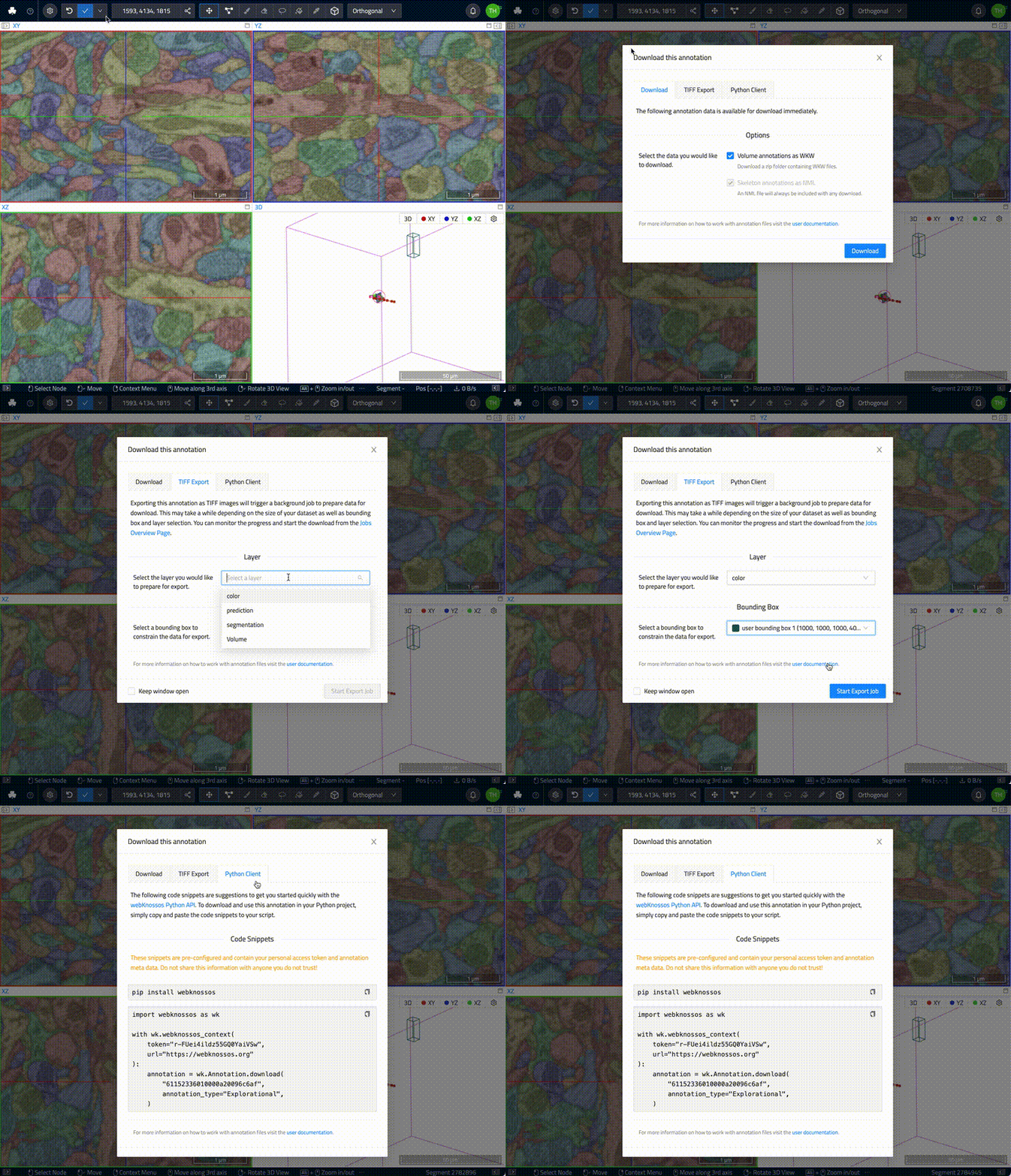
The "Download" dialog for exporting and downloading annotations and dataset layers. WEBKNOSSOS offers downloads as Tiff stacks, the native WEBKNOSSOS file formats, and through the Python library.
To export skeleton trees, nodes, and edges as CSV files, use the Skeleton (Trees) tab in the right-hand sidebar rather than the Download dialog.
Exporting TIFF / OME-Zarr cutouts
To export a cutout of your data as a TIFF stack, OME-TIFF, or OME-Zarr:
- Open the
TIFF and OME-Zarr Exporttab in theDownloaddialog. - Pick the layer to export.
- Choose a bounding box, either one of your user-defined bounding boxes or the full layer.
- Choose the format (TIFF stack, OME-TIFF, or OME-Zarr) and a magnification.
- Start the export.
OME-Zarr exports are delivered as a single .ozx file, a zipped OME-Zarr store following NGFF RFC-9. It contains the selected magnification plus all coarser ones already available on the layer, and WEBKNOSSOS accepts .ozx files as an upload format as well.
TIFF and OME-Zarr exports run as a long-running job; you can track progress and download the result from the Jobs Overview page. Maximum volume and edge-length limits apply to the selected bounding box.
- Get Help
- Community Forums
- Email Support